

















HLVd in Cannabis: Biology, Spread, and Detection
HLVd is not a visible disease problem. It is a production and economic problem that often goes undetected without molecular testing.
Science reviewed by PhD scientists — peer-reviewed biological impact data & current market pricing, normalized to a 100 lb dry flower harvest baseline.
$887K worst-case revenue loss
30-70% dry flower yield reduction
30-70% cannabinoid & terpentene loss
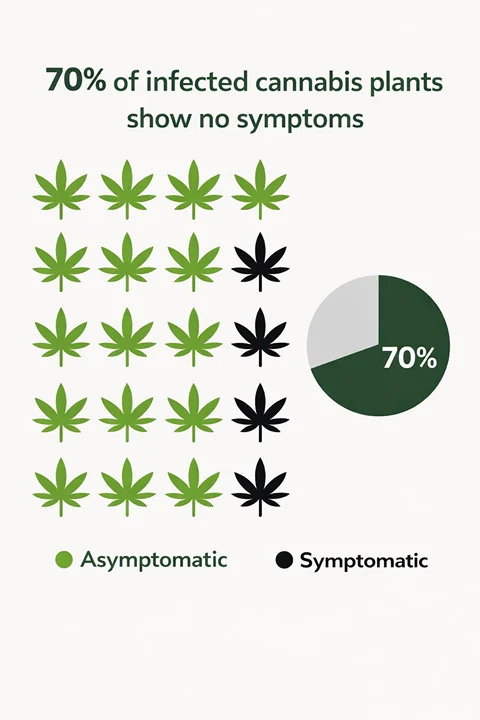
70% of infected plants show zero symptoms
What is HLVd?
Hop latent viroid (HLVd) is a small, circular RNA pathogen that disrupts normal plant function without encoding proteins. It interferes with gene expression, leading to reduced vigor, altered
morphology, and significant losses in yield and potency (Punja et al. 2023).
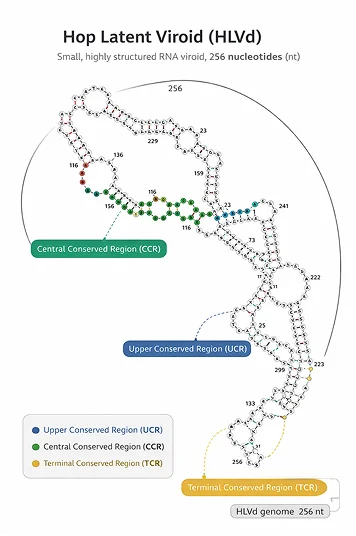
HLVd is a highly structured RNA molecule. It’s shape — not proteins — drives its interaction with host gene expression. Unlike viruses, viroids carry no protein coat and replicate entirely through host machinery.
The viroid exists as a circular RNA in vivo and may adopt multiple
conformations. Its intrinsic structural stability underlies its
persistence in plant tissue and its resistance to standard sanitation protocols.
- No protein coat
- Mechanical spread
- No cure
- No visible symptoms
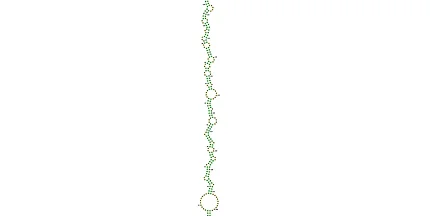
A: Minimum free energy (MFE) secondary structure of HLVd RNA (256 nt) predicted by RNAfold. B: Stylized secondary structure highlighting conserved functional regions (CCR, UCR, TCR) and the rod-like architecture that drives host gene expression disruption.
- No immune recognition. The plant has no molecular mechanism to detect and wall off the infection the way it can with viral or fungal pathogens.
- No vector required. Spreads mechanically — any tool or hand that contacts infected tissue can transmit it.
- No systemic treatment. Fungal infections can be managed with antifungals. Viroids cannot be eliminated from an infected plant by any chemical treatment available.
- No visible early symptoms. Replicates and accumulates for weeks to months before any phenotypic effect appears — if ever.
Viroid vs. Virus vs. Fungus
HLVd is a viroid — a class of pathogen that most growers have never encountered before cannabis. Understanding what makes viroids different from viruses and fungi explains why standard disease management strategies fail against them.
A viroid is a short, circular RNA molecule, typically about 250–400
nucleotides, with no protein coat and no coding capacity. Viroids consist only of RNA, with no capsid or envelope. Standard fungicides and bactericides do not target RNA pathogens like viroids, limiting traditional treatment options.
Viroids and viruses depend entirely on a living host cell to replicate.
Viruses are more complex than viroids. They contain genetic material (RNA or DNA) enclosed in a protein coat (capsid), and sometimes a lipid envelope. While they encode proteins
and use host machinery to replicate, there are no curative treatments for plant viral infections— only prevention and management.
Fungi are fundamentally different. They are living, cellular organisms with membranes, organelles, and cell walls. Unlike viroids and viruses, fungi grow, metabolize, and reproduce independently, which is why they can be targeted with antifungal treatments.
Viroids: RNA only, no proteins, no treatment targets
Viruses: RNA/DNA + protein coat, no curative treatments
Fungi: Living cells, metabolically active, targetable with antifungals
| Pathogen Type | Protein Coat | Treatment Exists | Visible Symptoms |
|---|---|---|---|
| HLVd (Viroid) | None | No | Often absent |
| Virus | Capsid | None (management only) | Variable |
| Fungus | Cell wall | Yes (antifungal) | Usually visible |
How HLVd Spreads
HLVd is primarily transmitted mechanically. This is a biosecurity issue, not a pest issue.

Shared tools
Scissors, pruning shears, and trellising equipment carry viroid RNA between plants
Human handling
Hands and gloves are high-risk transmission vectors during routine plant handling
Cloning from infected mothers
The highest-risk pathway — infected mother plants contaminate entire clone batches silently
Root-to-root transfer
Potential transmission in shared hydroponic or irrigation systems
Insect vector transmission has not been clearly demonstrated in cannabis under standard production conditions. Biosecurity protocols rather than pesticides remain the primary control strategy.
A single room holds the genetics that will produce every cutting for the next several months. If HLVd is present in one mother plant and tools are shared — standard practice without a testing protocol — the infection spreads laterally with each cutting session.
By the time HLVd is detectable by visual inspection, cuttings
from infected mothers have already been rooted, transferred to veg, and in many operations, moved into flowering.
Contamination doesn’t announce itself. The first signal most operations receive is a quality decline at harvest — loose buds, reduced trichome density, lower-than-expected cannabinoid tests. By that point, the viroid has been in the facility for a full production cycle or more.
What HLVd Does to the Plant
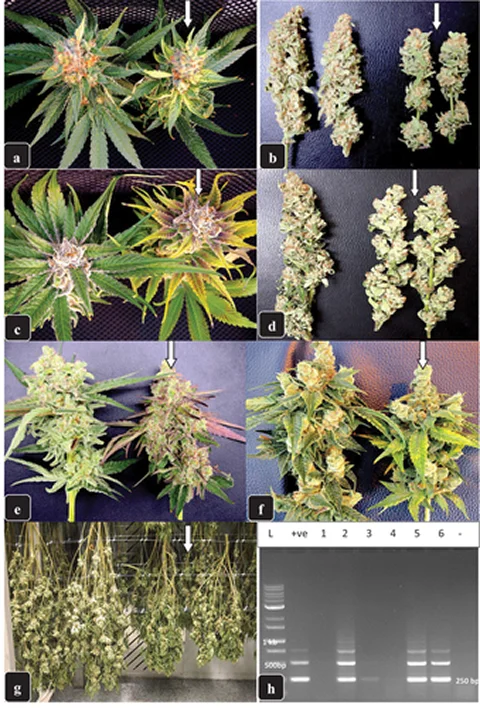
HLVd causes a range of physical symptoms in Cannabis sativa, though many infected plants show no visible signs — especially early in infection.
Reduced growth rate and biomass
Smaller, less dense flowers ("dudding" in severe cases)
Reduced cannabinoid and terpene production
Stunted internode development
Altered leaf morphology (in symptomatic cases)
Visual inspection is not a reliable screening method. Most HLVd-infected plants appear completely healthy — making molecular testing the only reliable detection pathway.
Visual inspection is not a reliable screening method. Most HLVd-infected plants appear completely healthy — making molecular testing the only reliable detection pathway.
HLVd Rarely Travels Alone
Cannabis Cryptic Virus (CCV) is consistently found alongside HLVd and independently drives similar quality suppression. Testing for HLVd alone does not rule out CCV or co-infecting fungal pathogens.
Cannabis Cryptic Virus (CCV)
A double-stranded RNA virus in the Partitiviridae family. Asymptomatic in most infections, spreads mechanically, no curative treatment. Identified as a
widespread co-infector in the same research wave that documented HLVd
prevalence. Combined pathogen load
drives additive suppression of secondary metabolite production.
A negative HLVd result says nothing about CCV.
Fusarium & Pythium
Fusarium oxysporum, Fusarium solani, and Pythium myriotylum frequently co-occur with viroid infections. Plants with compromised metabolic function due to viroid infection may be more susceptible to secondary fungal infections.
Silent root infection — often mistaken for overwatering.
Botrytis cinerea
Favors the same high-humidity, high-density environments as cannabis production. Can be driven by compromised plant vigor from viroid infection, creating cascading losses at
harvest that appear environmental in origin.
Gray mold at harvest may signal deeper pathogen load.
MyFloraDNA's multiplex panels detect 3 in 1 pathogens
Pathogen Shield: HLVd, Fusarium oxysporum, and Pythium myriotylum
Flower Failure, General Decline, and Wilting panels: Fusarium oxysporum, Fusarium solani, and Botrytis cinerea quantitative load data.
HLVd is a Pricing Problem
Reduced potency shifts flower out of its price tier — and that is where the real damage happens.
$887K Worst-case loss · 100 lb harvest
Two simultaneous hits. Most growers only expect one.
Infected plants experience yield loss (30–70% fewer sellable pounds) and potency loss (30–70% reduction in cannabinoids and terpenes) simultaneously. These effects compound.
As THC declines, product value drops from premium to mid-grade or extraction-grade pricing. The result is not just less product — it is less valuable product.
Hit 1 — Yield Loss
30 to -70% dry flower yield reduction per harvest
Hit 2 — Potency Collapse
30 to -70% cannabinoid & terpene production loss
= Flower drops out of its price tier entirely
$20/g per gram
$12/g per gram
$7/g per gram
HLVd pushes your harvest down this chain
Why THC Disappears: Trichome Collapse
HLVd reduces trichome head size and structural integrity — directly limiting cannabinoid and terpene production at the cellular level.
In healthy plants, trichomes develop large, turgid heads on long stalks — the primary site of cannabinoid synthesis. HLVd disrupts this development, producing smaller, collapsed trichome heads with compromised structural integrity.
This is the direct cellular mechanism behind the 30–70% potency reduction. While trichomes remain present, their reduced size dramatically limits cannabinoid accumulation per gram of flower.
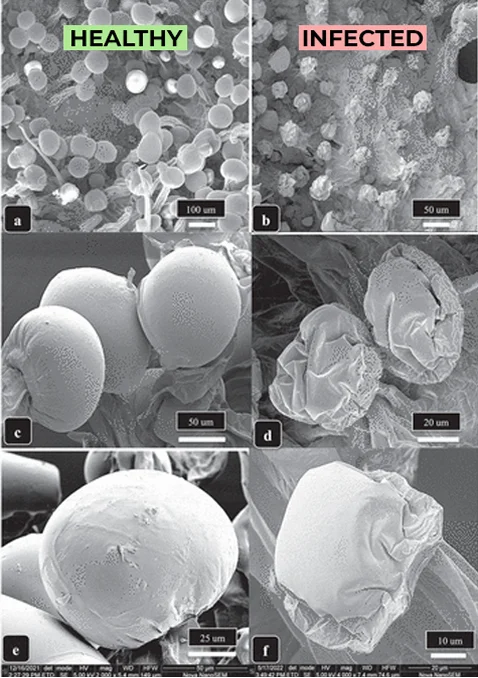
Trichome morphology (Punja et al. 2024): Healthy trichomes are large and turgid; HLVd-infected trichomes are smaller and collapsed, directly reducing cannabinoid production.
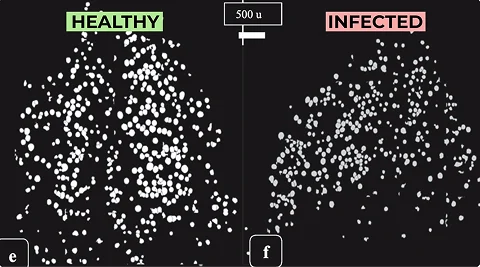
Trichome distribution: Reduced density in HLVd-infected inflorescences driven by smaller, collapsed glandular heads. Image: Punja et al. 2024.
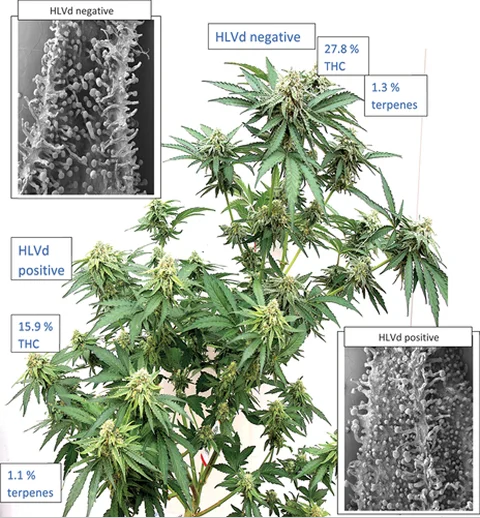
THC & terpene reduction: HLVd reduces THC and terpene levels within the same plant, causing direct loss in product quality and market value. Image: Punja et al. 2024.
How HLVd is Detected
Visual inspection cannot reliably detect HLVd. Molecular testing is
the only method that catches infection before it reaches the production system.
HLVd-infected plants look normal for most or all of their production cycle. The symptoms that do appear are indistinguishable from dozens of other causes — genetics, light stress, nutrient imbalance.
No experienced grower can reliably differentiate an HLVd-infected plant by observation alone.
Tissue sample collected
Leaf punches or one-inch root sections collected per plant. No equipment or training required — collection kit provided.
RNA extraction & qPCR amplification
The assay targets a conserved region of the viroid’s RNA sequence. If HLVd is present — even weeks before any symptom — the assay amplifies it and generates a quantitative signal.
Ct value reported — not just positive/negative
High load (low Ct) = immediate quarantine. Low load (high Ct) = monitoring and re-test. This triage information drives operational decisions and is only available from quantitative
testing.
Results via MyFloraCLOUD
Accessible from any device. Full report downloadable as PDF. Facility-level trends tracked over time.
Validated Panel Standards
- Limit of detection characterized for each target
- Specificity confirmed against non-target species
- Reproducibility verified across independent runs
- Positive and negative controls on every run
- Results reviewed by PhD scientists
A negative result without a passing positive control is not a reliable negative. This is a basic standard of validated molecular diagnostics that not all cannabis testing providers mantain.
Know your pathogen status before your next harvest.
Submit a sample and get quantitative results via MyFloraCLOUD.
Frequently Asked Questions
HLVd is a viroid — a circular strand of RNA with no protein coat. Viruses have protein capsids and often lipid envelopes. Viroids are smaller, have no structural proteins to target with treatment, and replicate by exploiting plant RNA polymerase directly. This is why no antiviral treatment works against HLVd.
Current evidence suggests HLVd can be seed-transmitted, though the rate appears lower than mechanical transmission. Seeds from infected plants should be treated as a risk factor. Any new genetics entering a facility — whether clones or seeds — should be screened before entering the propagation environment.
Quantitative PCR can detect HLVd within weeks of infection — long before any visual symptoms appear. In practical terms, PCR testing at incoming genetics intake and quarterly mother room screening will catch infection well before it reaches flowering.
No. There is no curative treatment for HLVd in established cannabis plants. The only reliable route to pathogen-free genetics from infected stock is meristem tissue culture. All infected material must be removed from the propagation environment on confirmation.
No. Susceptibility varies by cultivar. Some cultivars show dramatic symptomatic responses; others carry significant viroid load with minimal visible effect. Cultivars with minimal visible symptoms are particularly dangerous in a mother room context because they spread HLVd widely before anyone suspects a problem.
Resources
Related Guides
Diagnostics, biosecurity, and remediation guidance