



















Reality
The cost of waiting too long
HLVd destroys revenue before it destroys plants. By the time visible symptoms appear, the infection has typically been spreading through your facility for months. Proactive multiplex pathogen testing is the only way to catch it before it reaches your bottom line.
57-98% Revenue lost to HLVd
Infection spreads silently through your operation
$2M+ Annual revenue at risk
Detection now prevents catastrophic loss
$887K Lost per 100 lb harvest
Infection spreads silently through your operation
Threat
The Hidden Risk in Commercial Cannabis Production
Most crop pathogens announce themselves with visible wilting, discoloration, or die-back. HLVd is different. Infected plants grow, flower, and develop through much of their cycle looking essentially normal — perhaps slightly tighter internodes, marginally smaller leaves. Easy to attribute to genetics or environment.
- Spreads without warning
- Erodes yield and quality silently
- Collapses yield overnight

Even 10% yield loss paired with just 30% THC reduction produces 68.5% revenue loss. It's not the biomass reduction that kills you — it's the pricing tier collapse.
By the time the real damage surfaces — loose buds, sparse trichomes, weakened aroma — the infection has already moved through your propagation system. Peer-reviewed research confirms up to 50% reduction in cannabinoid and terpene production in susceptible cultivars.
The financial danger isn’t the yield reduction alone. It’s what happens to your price per gram. Cannabis is priced by quality tier, not by weight. When HLVd drops a 30% THC cultivar to 14%, that product doesn’t sell for slightly less — it falls out of the premium category entirely and into extraction or salvage pricing. From $20/gram to $7/gram. On a 100 lb harvest, that’s the difference between $907,000 and $81,000 — from a biological impact that looked moderate.
HLVd in Cannabis: Biology, Spread, and Detection
The full biology of Hop Latent Viroid — how it spreads, what it does to the plant, and how molecular testing detects it.
What's at Stake
Revenue Loss by Severity
The following economic analysis was developed by Anna Schwabe, PhD, using peer-reviewed biological impact data and current market pricing, normalized to a standard 100 lb dry flower harvest baseline.
| Scenario | Low Tier ($7/g) | Mid Tier ($12/g) | High Tier ($20/g) |
|---|---|---|---|
| Healthy Crop | $317,520 | $544,320 | $907,200 |
| Moderate HLVd | $158,760 (-57%) | $226,800 (-58%) | $317,520 (-85%) |
| Severe HLVd | $68,040 (-79%) | $81,648 (-85%) | $136,080 (-92%) |
| Worst Case | $17,010 (-94%) | $23,814 (-96%) | $34,020 (-98%) |
Source: Schwabe, PhD (2026). Yield loss 30–70%, THC reduction 30–70%, based on published field data.
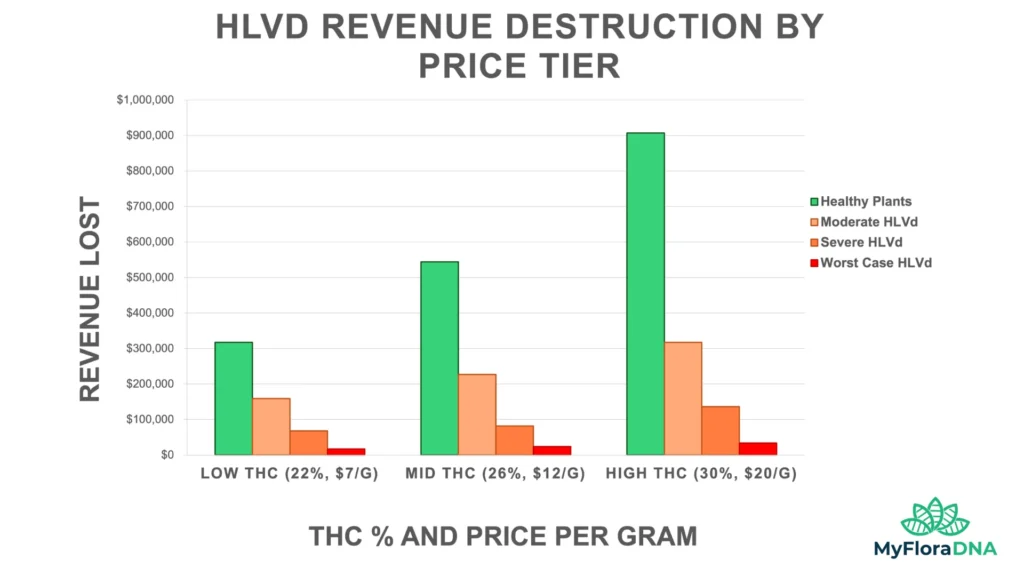
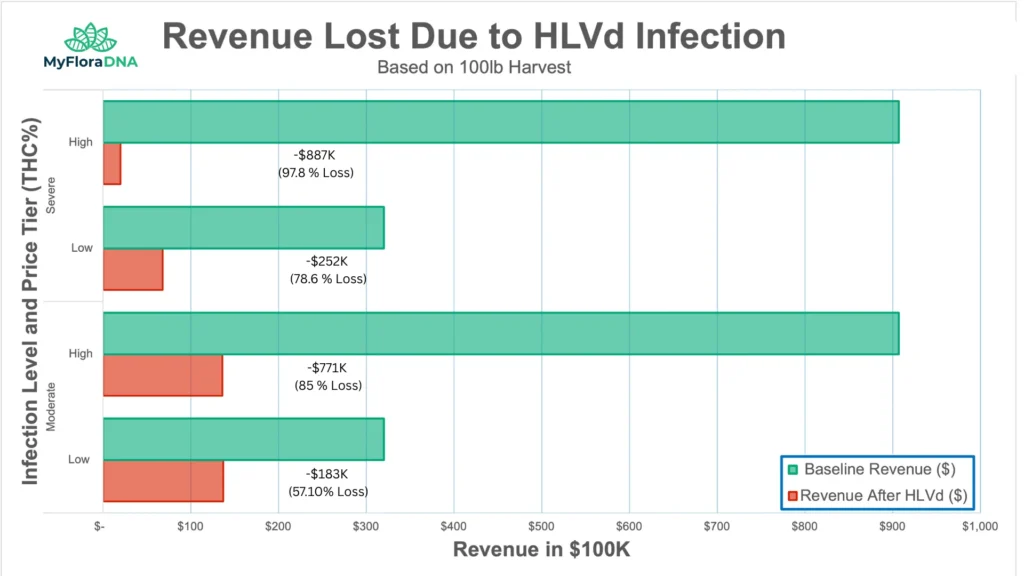
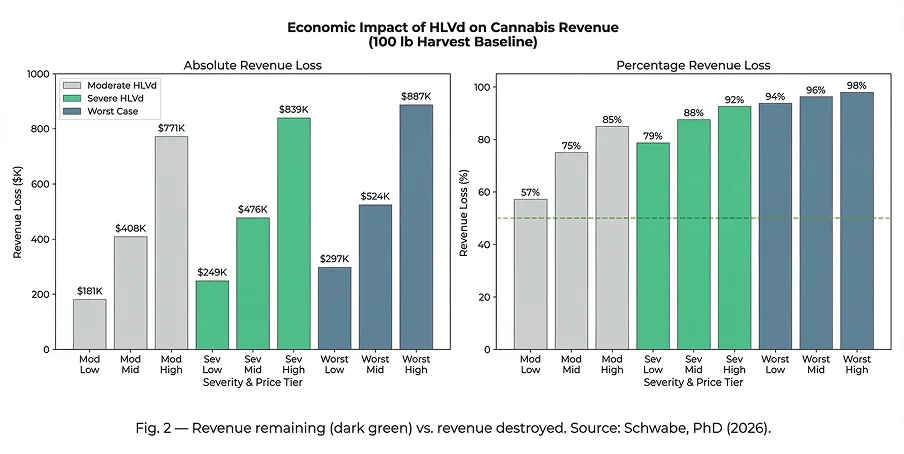
For facilities running 4–5 harvests annually, undetected moderate HLVd infection translates to $1.2M–$2M+ in annualized revenue loss at mid-to-high THC tiers — compounding every cycle the infection goes undetected.
Economic Impact of HLVd on Cannabis Revenue
Full methodology, scenario modeling, and the pricing tier collapse explained in detail.
Why One-Test-at-a-Time PCR Falls Short
Many cannabis operations still use single-pathogen PCR ordered reactively after a problem is suspected. This approach has three compounding weaknesses that leave commercial growers exposed.
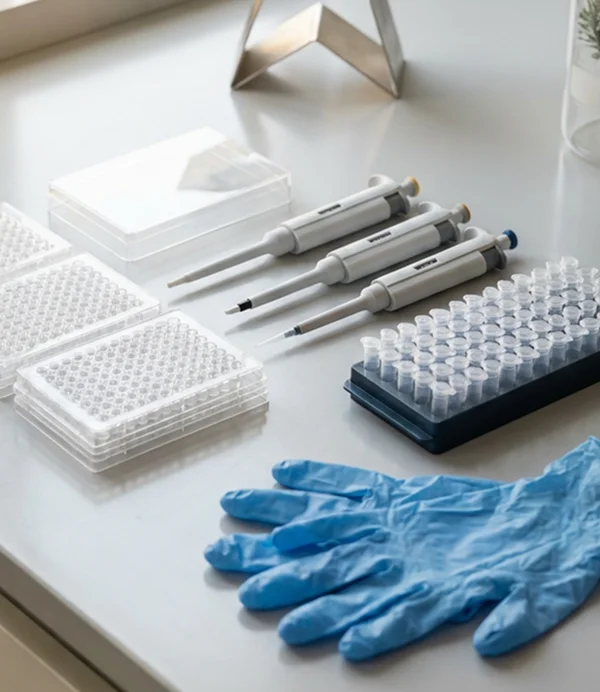
It only answers one question at a time
Cannabis plants frequently carry co-infections. Cannabis Cryptic Virus (CCV) is commonly found alongside HLVd and can drive similar quality suppression independently. A negative HLVd result says nothing about CCV, Fusarium, Botrytis, or powdery mildew pathogens that may be present simultaneously.
By the time you order it, it's already too late
Reactive testing — triggered by visible symptoms — means the infection has already spread. In a mother room, that translates directly to infected cuttings distributed across flowering rooms before a single result returns.
Sequential assays cost more and deliver less
Running three individual pathogen assays takes longer and costs more than a single validated multiplex panel — and still produces fragmented information that can’t be interpreted in the context of co-infection.

One test answers every question at once
MyFloraDNA’s multiplex qPCR panels detect up to three key pathogens per test, selected based on symptom presentation.
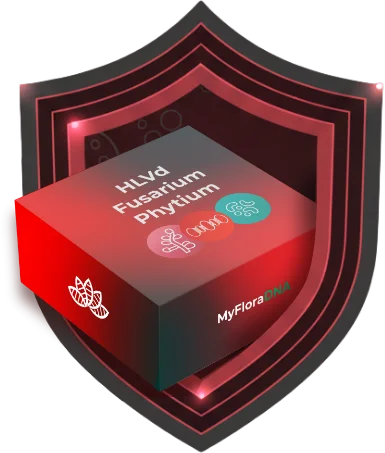
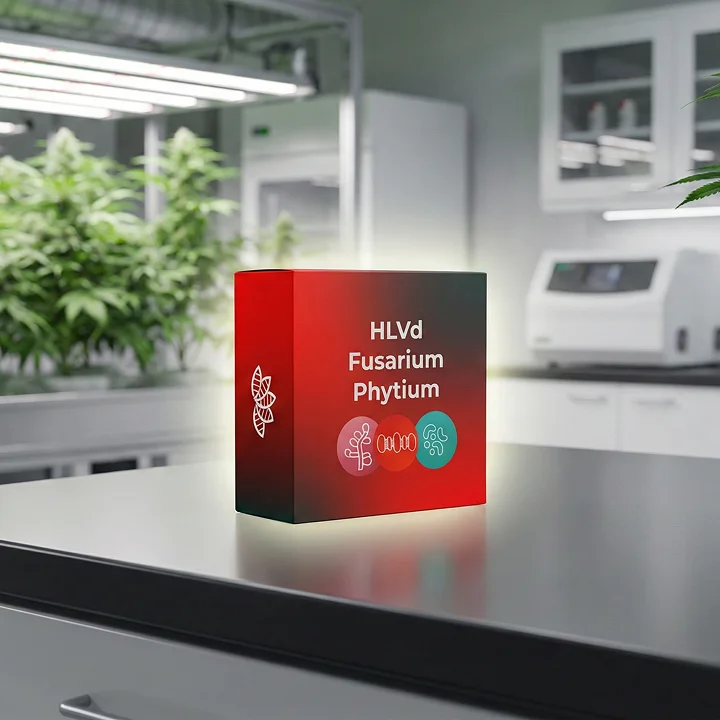
Pathogen Shield screens for Hop Latent Viroid (HLVd), Fusarium oxysporum, and Pythium myriotylum in a single run.
Our Pathogen Panels group three likely pathogens that cause similar symptoms, helping you quickly identify what’s actually driving plant decline.
Quantitative results show not just presence, but infection load so you can make informed decisions early.
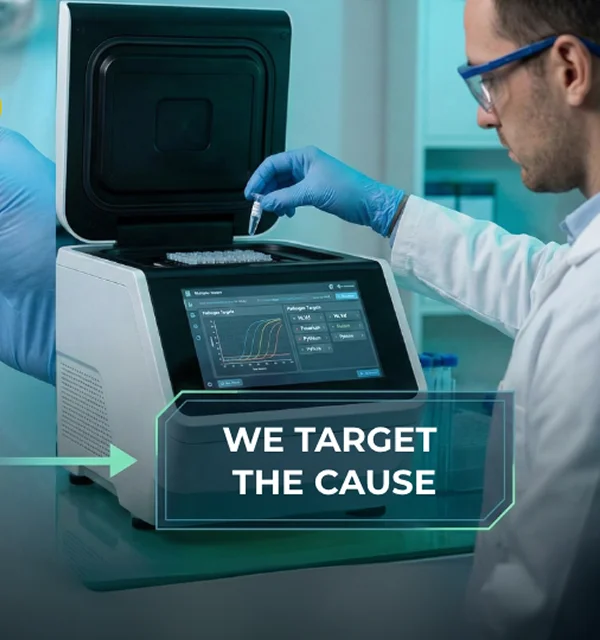

What is multiplex qPCR?
Learn how multiplex qPCR detects multiple pathogens at once, why it outperforms single-target tests, and what to look for in a validated panel.

Why visual diagnosis misses what matters
Most costly infections show no clear symptoms until it’s too late. Learn when molecular testing is the only reliable answer.
Strategy
Structured Pathogen Panels for commercial growers
Effective diagnostics aren’t about testing everything all the time — they’re about testing the right things at the right points in your production cycle.

Incoming genetics
Full HLVd + CCV + fungal panel before any new material enters your facility. External genetics are the highest-risk introduction point.

Mother room
Quarterly (minimum) viroid screening across all mother plants to catch latent spread before it reaches propagation or flower.

Pre- and post- tissue culture
Test before TC entry and verify clean status after regeneration. Tissue culture does not guarantee pathogen-free plants without testing.

Unexplained yield or quality decline
Run a full diagnostic panel to identify root cause and rule out co-infection before making remediation decisions
Strategy
If it goes into propagation, it gets tested first
A panel costs hundreds of dollars. A contaminated mother room or mother plant costs hundreds of thousands per cycle, compounding across every harvest until the problem is identified.
Cannabis Mother Room Biosecurity Guide
Practical biosecurity protocols for mother rooms: testing cadence, sanitation, quarantine procedures, and clean stock maintenance.
Tissue Culture and Clean Stock Strategy
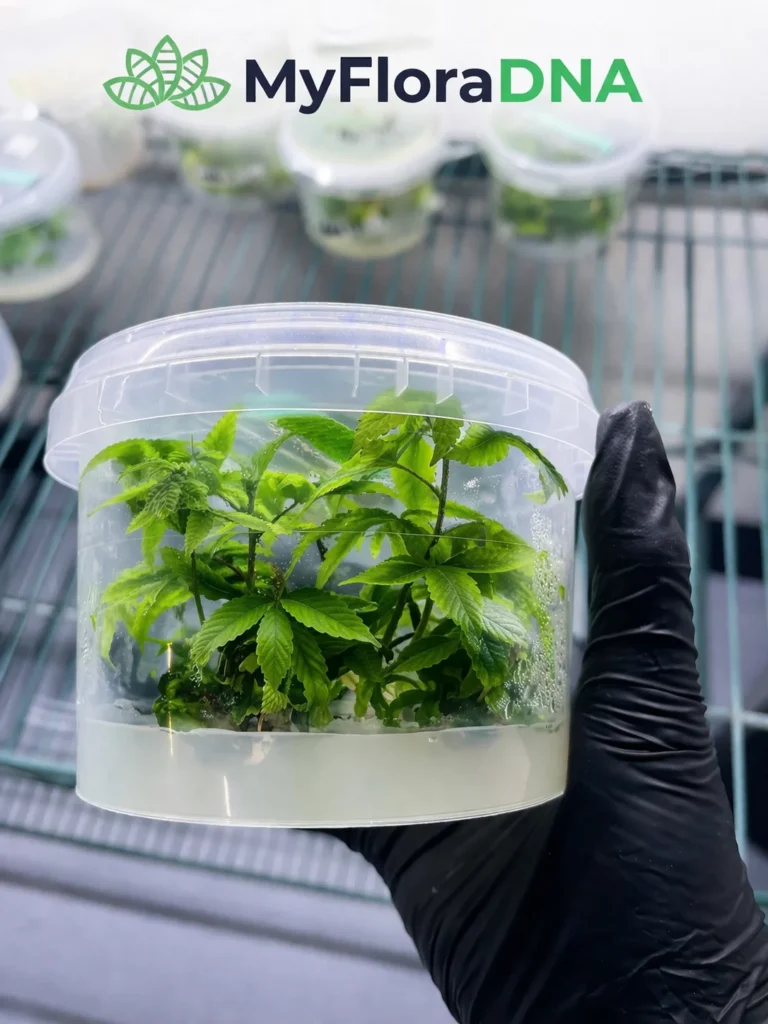
If HLVd is confirmed in a cultivar you rely on, meristem tissue culture is the only reliable path to clean genetics. The process involves excising the apical meristem — a small dome of undifferentiated cells at the growing tip — and regenerating whole plants under sterile conditions. Because viroids are not uniformly distributed across all plant tissues, and meristematic cells divide rapidly, this process can produce pathogen-free plants from infected stock.
The critical requirement: diagnostics at every checkpoint. Tissue Culture without testing before entry and after regeneration is incomplete. MyFloraDNA supports pre-TC screening, post-TC verification before plantlets leave the laboratory, and pre-propagation clearance before clean stock enters multiplication.
Validation
Laboratory validation and scientific standards
A diagnostic result is only as useful as the confidence behind it. MyFloraDNA’s panels are validated against defined performance criteria: limit of detection characterized for each target, specificity confirmed against non-target species, and inter-run reproducibility verified across independent runs.
Every run includes positive and negative controls. A negative result without a passing positive control is not a reliable negative. This is a basic standard of validated molecular diagnostics that not all cannabis testing providers maintain.
Panels are developed and validated by PhD scientists, grounded in published peer-reviewed literature, and suitable for clean stock certification programs.
When you make a quarantine or propagation decision based on a MyFloraDNA result, you’re making it on data you can defend.
Tissue culture and clean stock strategy
If HLVd is confirmed in a cultivar you rely on, meristem tissue culture is the only reliable path to clean genetics — and MyFloraDNA’s integrated platform is built around it.
What is a Gen 0 plant?
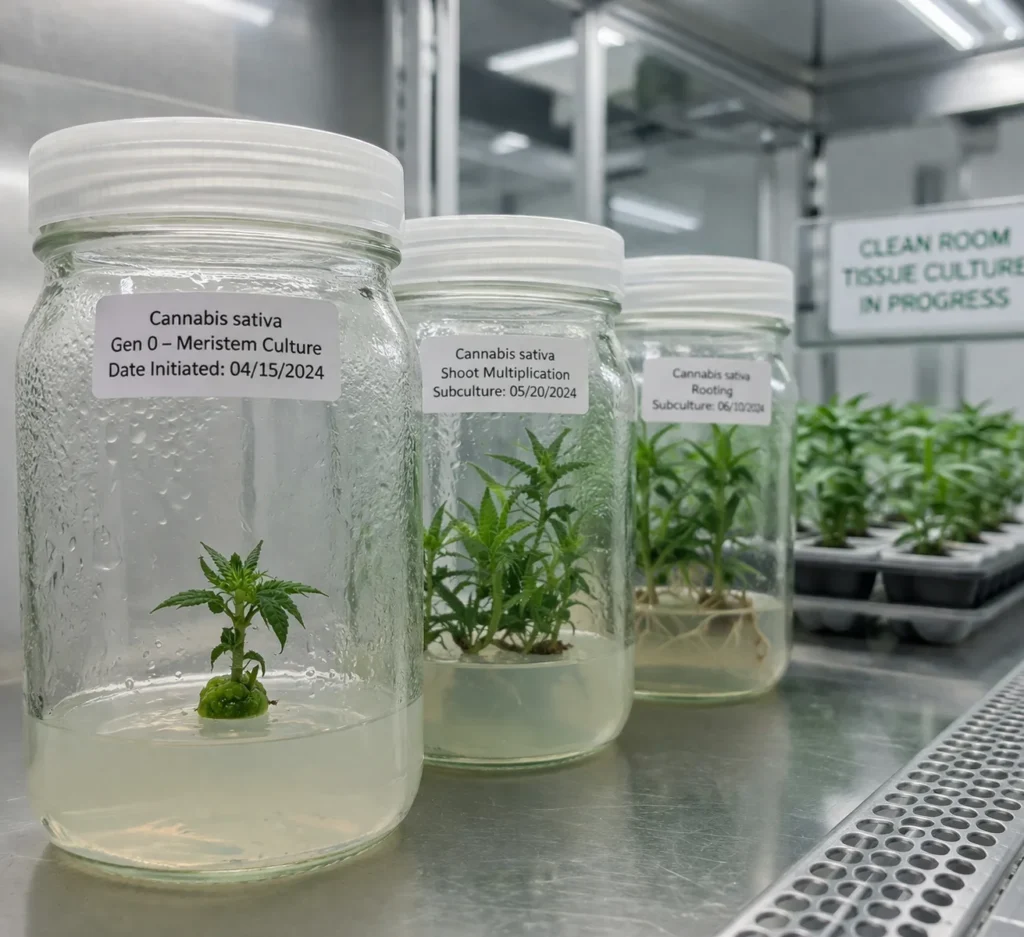
A Gen 0 (Generation Zero) plant is regenerated directly from sterile tissue culture — not cut from a mother plant. It’s the first generation rebuilt from clean, actively dividing tissue. No accumulated mother-room stress. No repeated cutting cycles. No pathogen history carried forward. It is a biological reset for your genetics.
How the process works
Meristem culture involves excising the apical meristem — a small dome of undifferentiated cells at the growing tip — and regenerating whole plants under sterile laboratory conditions. Because viroids and many pathogens are not uniformly distributed across all plant tissues, and because meristematic cells divide rapidly and can outpace viroid replication, this process can recover pathogen-free plants from infected stock. It is the only reliable method for doing so.
Diagnostics are built into every step
Tissue Culture without diagnostics at every checkpoint is incomplete. MyFloraDNA runs in-house qPCR testing before any material enters the culture pathway. If the incoming material is clean and responsive, it proceeds to nodal culture with a standard 16-week timeline. If infection is detected, it enters the meristem recovery pathway — with extended timelines communicated upfront. After regeneration, plantlets are verified before leaving the laboratory. Before multiplication, clean stock is cleared again. Every checkpoint is a firewall.
What you get back
MyFloraDNA’s Genetic Renewal program returns 15 verified Gen 0 plants per sample — pathogen-screened, regenerated from clean tissue, and ready to anchor your next propagation cycle. Optional DNA fingerprinting confirms genetic fidelity throughout. For operations needing scale, Micropropagation delivers batch quantities of verified Gen 0 stock on a calendar you define. For rare or legacy genetics, Controlled Genetic Banking holds cleaned cultivars in secure laboratory storage at $60 per cultivar per month — production ready whenever you need them.
Fusarium can destroy your harvest before you see a single symptom.
Fusarium oxysporum and Fusarium solani are soil-borne fungal pathogens that attack cannabis root systems silently. In the early stages, infected plants may show only mild wilting or slight yellowing — symptoms growers routinely attribute to overwatering, nutrient issues, or environmental stress. By the time vascular discoloration, root rot, or plant collapse becomes visible, the infection has typically spread through the root zone and into neighboring plants. In warm, moist growing environments, Fusarium spreads rapidly. It can also be introduced through infected seed propagation — meaning it may already be in your facility before the first cut is ever taken.
MyFloraDNA tests for Fusarium oxysporum and Fusarium solani in the Pathogen Shield™, Wilting Panel™, Leaf Spot Panel™, Flower Failure Panel™, and General Decline Panel™ — because by the time you can see it, it's already too late.
FAQs
Understand what early detection means for your operation
On a 100 lb high-tier crop ($20/g, 30% THC), moderate HLVd produces losses exceeding $771,000 — an 85% revenue reduction. Worst-case destroys 98% of revenue. For facilities running 4–5 harvests annually, undetected moderate infection can exceed $1.2M–$2M in annualized losses.
No. Cannabis Cryptic Virus (CCV) frequently co-infects alongside HLVd and independently drives yield and quality suppression. A single-pathogen HLVd assay can return negative while CCV and fungal pathogens go undetected. Multiplex panels provide the complete picture.
At minimum: all incoming genetics before facility entry, mother room quarterly, and all material before and after tissue culture. For operations receiving frequent external genetics, monthly mother room monitoring is recommended.
Quantitative PCR measures pathogen concentration, not just presence. High viral load in a mother plant means immediate quarantine. Low load may warrant monitoring and re-test. That distinction directly shapes your triage decision — binary results can’t do that.
No. There is no curative treatment for HLVd in established cannabis plants. The only reliable remediation is meristem tissue culture, supported by rigorous pre- and post-TC diagnostic testing. All infected material should be removed from the propagation environment immediately upon confirmation.
Resources
Related Guides
Diagnostics, biosecurity, and remediation guidance