


















The most critical diseases and viroids of cannabis in California include Hop Latent Viroid, root and crown rots, powdery mildew, bud rots, and post-harvest flower molds.
This article aims to help cannabis growers improve their understanding of these diseases and adopt appropriate management practices to limit the introduction, establishment, and spread of the pathogens — and reduce the damage they cause to cannabis production in California.
The most significant challenge cannabis and hemp producers face is managing the insect pests and pathogens that attack the roots, leaves, and inflorescences. Using symptomatology and morphological criteria is not enough; molecular approaches for pathogen identification are currently the most comprehensive way available.
Powdery mildew
Description & distribution
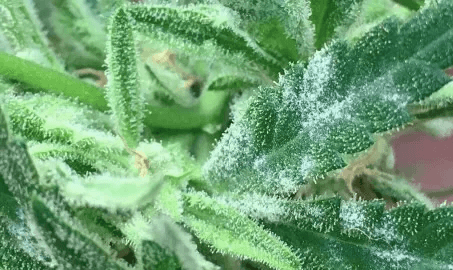
Powdery mildew is caused by Golovinomyces species, including G. cichoracearum, G. ambrosiae, or G. spadiceus. These pathogens are present in B.C., eastern Canada, the USA, and likely elsewhere. The host range may include other, yet undetermined, plant species. In outdoor-grown cannabis and hemp, powdery mildew may also be caused by Podosphaera macularis, the causal agent of powdery mildew on hops. Infection from hops to cannabis and hemp has been reported in New York but is very infrequent.
Symptoms
Powdery mildew may affect plants at all stages of growth, with symptoms on leaves, flowers, and occasionally stems. The pathogen’s mycelium and conidiophores appear as distinct white powdery patches on the upper surface of leaves, flowers, and occasionally stems. Masses of spores are produced and released when plants are disturbed. Infections may cause leaves to turn brown and drop prematurely; diseased plants may have stunted growth with poor-quality flowers. Infections are localized to the infected tissues — systemic infection and internal spread have not been demonstrated.
Transmission
Spores of Golovinomyces spp. spread primarily through the air, although contaminated clothing, equipment, and tools may also spread the pathogen to a lesser extent. It may be introduced into a facility on infected plants, including cuttings or mother plants. Severity and incidence are enhanced by rapid temperature and humidity fluctuations, high humidity, and inadequate air movement. Cannabis strains differ in susceptibility, so selecting resistant strains is essential.
Pythium crown and root rot
Description & Distribution
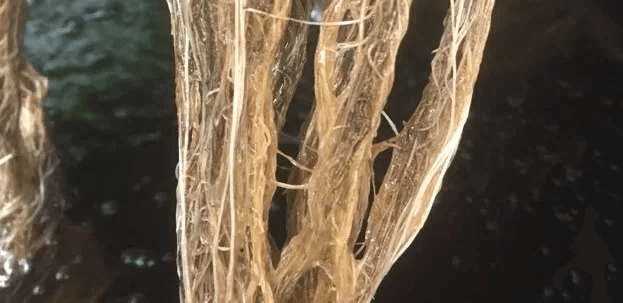
Several species of Pythium — including P. myriotylum, P. dissotocum, P. aphanidermatum, and P. ultimum — have been reported to infect cannabis in B.C. and other parts of North America. These water molds affect many greenhouse crops (pepper, tomato, cucumber, ornamentals) and field crops such as strawberries. Their host range is broad, so the pathogens may originate from and spread to other host plants.
Symptoms
Pythium causes roots to appear brown and rotten, with a distinct lack of feeder roots. The outer region of infected roots may easily slough off, leaving only the vascular tissue intact. Crown rot appears as dark, sunken lesions at the base of plants, extending several centimeters up the stems. Infected plants often show stunting, and leaves may later turn yellow. Wilting occurs rapidly under warm, sunny conditions. Diseased plants may emit an odor due to secondary bacterial invasion, especially in warm weather.
Transmission
Pythium produces mycelium, water-borne spores (zoospores), and long-lived oospores on diseased plants and in growing media. These spread by water, contaminated growing media, insects, and plant debris. Contaminated tools and equipment, including irrigation systems, may also spread it. Root damage and overwatering contribute to infection. The pathogen grows at 10–35 °C, thriving around 30 °C.
Bud rot (Botrytis)
Description & Distribution
Botrytis cinerea, also known as “grey mold,” is the primary cause of bud rot in B.C. and other regions of Canada and the USA. The pathogen can also cause stem canker on cannabis. The range of plant species affected by Botrytis is extensive — over 500 species.
Symptoms
Buds (inflorescences) affected by Botrytis initially appear soft and discolored. As symptoms progress, buds may turn crisp and brown. Infections commonly start in the interior of the buds — where humidity is highest and air movement lowest — and progress outward. Grey or off-white mycelial growth may be observed on affected buds, and under high humidity the pathogen sporulates to produce a characteristic grey mold. Stem cankers appear as slightly sunken tan or off-white areas on the main stem or at branching points where injury has occurred. Most infections occur in early fall and winter and rarely during warm summer months; the pathogen does not grow above 30 °C but can grow at 5–10 °C.
Transmission
Botrytis spreads primarily as airborne spores. Spread may also occur from infected plant debris, tools, equipment, and the clothing of staff and visitors. Adjacent susceptible crops may be a source of spores, while damaged tissue is more susceptible. The disease thrives in high relative humidity with poor air circulation and moisture condensation. Excessive nitrogen may predispose plants to infection. The risk of bud rot increases as buds reach maturity, and strains with large, densely packed inflorescences are more susceptible than loosely arranged flowers.
Virus and viroid diseases
Description & Distribution
Confirmed reports of viruses affecting cannabis remain low. However, samples recently diagnosed using molecular approaches confirm that Tobacco Mosaic Virus, Cucumber Mosaic Virus, and Alfalfa Mosaic Virus are present in cannabis plants in California. These viruses have wide host ranges and affect other crops such as tomato and cucumber. Hop Latent Viroid (HLVd) has been reported to infect cannabis in California, other areas of the USA, and Canada. HLVd also infects hops and is distributed in hop-growing regions worldwide, where it causes no symptoms (i.e., it remains latent).
Symptoms
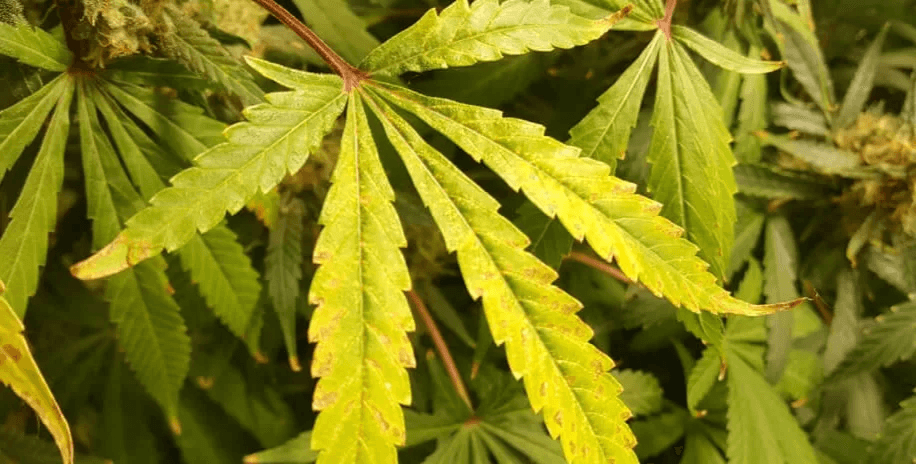
Virus symptoms include alternating patterns of yellow and green (mosaic), yellowing on certain parts of the plant, or curling, distortion, and narrowing of young leaves. Line patterns may also appear on diseased leaves. The effects on yield and flower quality have not been determined. HLVd symptoms include stretched and horizontal growth, brittle stems, malformed or chlorotic leaves, and stunting. Plants may also “dud” when flowered, with small, malformed flowers and reduced secondary metabolites. Plants may remain asymptomatic but still harbor HLVd or viruses.
Watch Out
Virus symptoms are easily confused with nutrient deficiencies (iron, magnesium, or nitrogen) that cause yellowing or striping, with abiotic stresses that distort or curl leaves, with stunting from poor environmental conditions, and even with herbicide injury.
Transmission
These viruses and viroids may be brought into the growing environment via infected mother plants, cuttings, and potentially seeds. HLVd and viruses can spread through contaminated tools, equipment, and the hands and clothing of staff — especially during pruning and handling of plants.
Other emerging pathogens
Other potentially important pathogens observed on cannabis in California that producers should be aware of include:
- Alternaria stem canker and bud rot
- Sclerotinia stem canker and bud rot
- Stem cankers caused by Diaporthe, Neofusicoccum, and Lasiodiplodia spp.
Control measures for cannabis diseases
In general, maintaining clean and sanitary conditions in cannabis growing facilities can reduce the incidence of many diseases. You can minimize the potential spread of pathogens by:
- Using footbaths at the entrances to growing areas, and hairnets, beard nets, and gloves for visitors and staff.
- Using air filtration and purification systems (HEPA filters, UV) to reduce airborne contaminants.
- Maintaining appropriate humidity and air-temperature levels and improving air circulation in production and post-harvest (drying) areas to prevent powdery mildew, Botrytis bud rot, and post-harvest decay.
- Minimizing damage to buds during harvest and trimming to reduce post-harvest decay.
- Treating irrigation water with UV, chlorine, or other registered products to prevent root rot, crown rot, and damping-off.
- Scouting for and removing diseased plants and tissues to minimize inoculum buildup.
- Using disease-free planting stock or cuttings from healthy mother plants, and quarantining and inspecting all incoming plant material.
Conclusion
Over the past four years, many fungal, viral, bacterial, and nematode pathogens have been reported to cause diseases on cannabis and hemp crops in North America. This article has summarized these diseases and discussed mitigation approaches. Implementing certified pathogen-free planting material is an essential first step, followed by biological control agents — which still require research to determine their comparative efficacies and modes of action.
The surge in cannabis and hemp cultivation is creating many opportunities for collaboration between growers and testing laboratories to solve emerging disease problems and ensure that consumer safety always remains a top priority.
“Know your enemy” is vital to control diseases early.
MyFloraDNA laboratory offers a variety of testing services, including pathogen detection, genetic testing, and whole-genome sequencing. As soon as we receive samples, we guarantee a rapid turnaround with results from our lab straight to the grower’s hands. Selecting the right plant stock is very important to grow disease-free plants — our main goal is to help you grow healthy, secure cannabis, improve your production, and preserve the quality of your main strains.
KNOW YOUR ENEMY — TEST EARLY
Pathogen detection, genetic testing, and whole-genome sequencing, with rapid turnaround from our lab to your hands.